
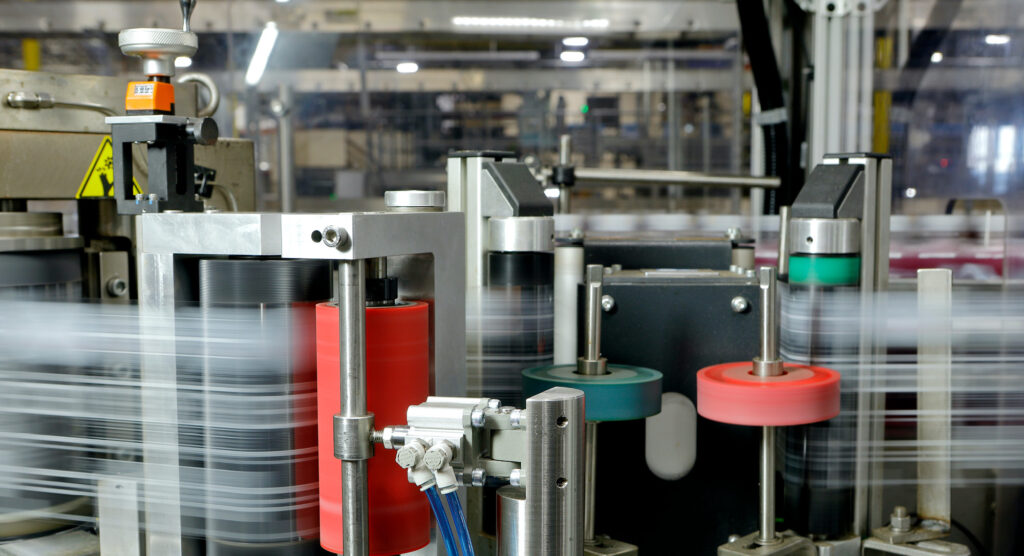
If you are evaluating labeling technology for your bottling operation, you have likely already landed on the two most common technologies in the industry: roll-fed labeling and pressure-sensitive labeling. Both have earned their place in production environments, and both come with real trade-offs that deserve a careful look before you commit.
This guide breaks down how each technology works, where each one performs best, and what factors should drive your decision. Whether you are running a high-volume beverage line or managing a diverse product mix, the right choice comes down to your specific production demands and long-term goals.
How Roll-Fed Labeling Works
Roll-fed labeling, feeds a continuous web of label film from a roll. The machine cuts individual labels from the web and applies them directly to containers using hot melt adhesive, wrapping the label around the container as it moves through the line.
This method is widely used in beverage, food, and chemical production because it supports high-speed operation and handles large volume output efficiently. Label material costs are typically lower compared to pressure-sensitive because the labels themselves do not require a liner or pre-applied adhesive backing.
Key characteristics of roll-fed labeling:
- High throughput capability, well-suited for continuous production runs
- Lower per-label material cost at scale
- Supports full wrap-around label coverage on bottles and containers
- Requires precise adhesive application and label registration for consistent results
- Changeovers involve mechanical adjustments and recipe settings
How Pressure-Sensitive Labeling Works
Pressure-sensitive labels, also called self-adhesive labels, come pre-coated with adhesive on a liner. The labeling machine peels each label from the liner and presses it onto the container. No heat or glue system is required at the machine level.
This technology is popular for short runs, variable data applications, and products that require precise front-and-back label placement. It is also a common choice for operations that frequently switch between SKUs.
Key characteristics of pressure-sensitive labeling:
- Simpler mechanical setup with no adhesive system to manage
- Faster and easier changeovers between different container formats
- Higher per-label material cost due to liner and pre-applied adhesive
- Generates liner waste, which adds to disposal costs and sustainability concerns
- Well-suited for smaller run sizes and label design flexibility
Head-to-Head: Key Comparison Factors
Production Volume and Speed
For high-volume, continuous production, roll-fed labeling holds a clear advantage. The economics of label material cost and machine throughput favor roll-fed technology when you are running tens or even thousands of containers per shift. Pressure-sensitive systems are capable at moderate speeds but become less cost-effective as volume scales up.
Label Material Cost
Roll-fed film labels are generally less expensive per unit because they arrive as a plain web without a liner or pre-applied adhesive. At scale, that difference adds up quickly. Pressure-sensitive labels carry a cost premium, but that premium can be justified when run flexibility and fast changeovers are priorities.
Changeover Time and Flexibility
Pressure-sensitive has historically offered faster changeover between formats. The most modern roll-fed system, however, has eliminated this past gap with recipe-driven controls and servo-driven automation that reduce or eliminate manual adjustment time and user errors.
Adhesive Management
Roll-fed labeling requires an active adhesive system, which historically has been a maintenance challenge. Glue temperature, viscosity, pattern consistency, and cleanup are all variables that 50 year old glue wheel systems struggle to manage reliably. This is an area where computer controlled adhesive extrusion technology innovation has made an enormous difference in recent years.
Sustainability and Waste
Pressure-sensitive labels generate liner waste with every label applied. That liner must be collected and disposed of, which adds cost and complicates recycling goals. Roll-fed labels do not produce liner waste, making them a stronger fit for operations focused on sustainability and circular packaging.
When Pressure-Sensitive Is the Better Fit
Pressure-sensitive labeling tends to be the right choice when:
- You run short production runs with frequent SKU changes
- Your labels include variable data such as lot codes or expiration dates
- You need precise placement on flat or irregular surfaces
- Capital investment constraints favor a lower-cost machine entry point
- Your volume does not justify the material cost savings of roll-fed at scale
When Roll-Fed Is the Better Fit
Roll-fed labeling tends to be the right choice when:
- You run high-volume continuous production lines
- Lowering per-label material cost is a business priority
- Full wrap-around label coverage is part of your packaging design
- You need a system built for long production runs with minimal downtime
- Your sustainability goals include eliminating liner waste from the line
A Closer Look at Modern Roll-Fed Technology: PROTOS by Elum
For operations evaluating roll-fed technology, the machine itself matters as much as the method. The challenges that have historically made roll-fed labeling difficult, particularly adhesive management, mechanical complexity, and operator intervention, are exactly what we engineered PROTOS to solve.
PROTOS is a 100% servo-driven, roll-fed, wrap-around labeler, and it was built from the ground up to eliminate the persistent frustrations of traditional roll-fed systems.
A few standout capabilities worth knowing:
SYNAPSE Glue Adhesive System. PROTOS delivers complete control over adhesive weight, pattern, and on-the-fly positioning. The closed-loop, non-recirculating system eliminates glue slinging, reduces cleanup time, and removes the need for an expensive exhaust system, creating a cleaner and safer production environment.
100% Servo-Driven Operation. Every function on PROTOS is servo-controlled, including label feed, cutting, tension, and adhesive application. This means unmatched precision at high speeds and far fewer wear parts compared to mechanical systems.
Compact Footprint. PROTOS uses approximately 50% less floor space than traditional rotary machines, making it practical for existing line configurations without major infrastructure changes.
Recipe-Driven Changeovers. The HMI stores settings for multiple SKUs. Operators select a recipe and the servo motors handle the adjustments, minimizing downtime between jobs and reducing the need for manual intervention.
If you have been hesitant about roll-fed labeling because of past experiences with adhesive mess, inconsistent performance, or high maintenance demands, PROTOS was specifically designed to address those concerns.
Making the Decision
The honest answer is that neither technology is universally superior. Roll-fed labeling offers stronger economics and sustainability advantages at high volume. Pressure-sensitive offers greater flexibility and simplicity for variable, lower-volume operations.
The questions to ask yourself are straightforward:
- What is your daily container volume?
- How often do you change between SKUs?
- What are your per-label cost targets over time?
- How much floor space can you allocate?
- What are your sustainability commitments around packaging waste?
Answering those questions with honest numbers will point you toward the right technology category. From there, the machine you select within that category will determine whether that technology actually delivers on its potential.
If roll-fed is the direction your evaluation is heading, we are happy to walk you through how PROTOS performs against your specific line requirements. Reach out to our team to start that conversation.