
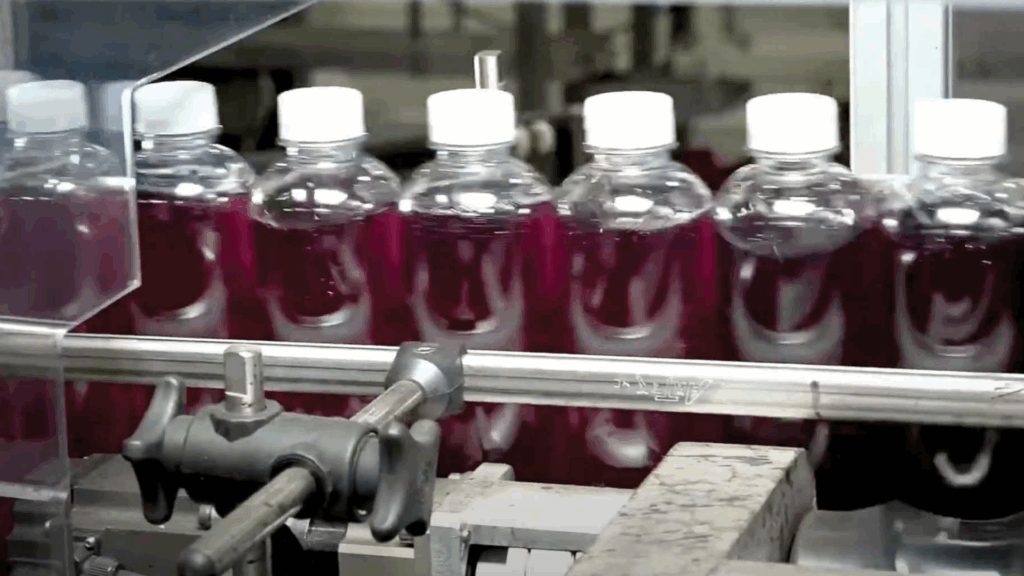
PROTOS is a 100% servo-driven labeling system capable of up to 700 bottles per minute, with recipe-driven changeovers completed within 15 minutes, engineered to eliminate manual adjustments across beverage, chemical. pharma, personal care, and any industrial production lines with cylindrical containers.
PROTOS at a Glance
Specification | Detail |
Max Throughput | Up to 700 bottles per minute |
Changeover Time | Within 15 minutes via pre-programmed recipes |
Drive System | 100% servo-driven |
Adhesive Control | Precision extruded adhesive system, eliminates glue-slinging and down time |
Changeover Method | Recipe-driven, no manual recalibration required |
Industries Served | Beverage, pharma/nutraceutical, personal care/cosmetics, chemical/industrial, Co-Man/Co-Pack |
Manufacturer | Elum Inc |
Introduction
In high-speed production environments, efficiency is everything. Every second of downtime, every inconsistency in output, and every manual adjustment required along the line adds up quickly. While many manufacturers focus on obvious bottlenecks, one of the most overlooked cost drivers in labeling operations is manual intervention.
Traditional labeling systems often depend heavily on operator adjustments to maintain performance. While this may seem manageable on the surface, the hidden costs associated with these adjustments can significantly impact productivity, consistency, and long-term operational efficiency.
The Reality of Manual Adjustments on the Production Floor
Manual adjustments are a standard part of operating many traditional labeling machines. Operators are frequently required to fine-tune machine components to maintain proper alignment, tension, and adhesive application. These adjustments are not limited to major changeovers, they occur continuously throughout production as conditions shift, materials vary, and equipment experiences normal wear.
Over time, this creates an environment where labeling performance depends heavily on operator input rather than system consistency. Even in well-managed facilities, this reliance introduces variability into a process that should ideally be precise and repeatable. Instead of running as a stable, automated system, the labeling process becomes something that must be constantly managed and corrected.
Labor Costs That Go Beyond the Obvious
The labor impact of manual adjustments often goes underestimated because it is spread across small, frequent interventions rather than one large, visible task. Operators are required to step in regularly to make adjustments, monitor performance, and troubleshoot issues as they arise. While each individual action may only take a few moments, the cumulative effect across an entire shift can be significant.
This ongoing involvement pulls skilled operators away from higher-value responsibilities and places them in a reactive role. Instead of focusing on optimizing production or identifying improvements, their time is spent maintaining baseline performance. Additionally, the need for experienced operators increases, less experienced team members may not have the knowledge required to make precise adjustments, leading to longer training cycles and greater dependency on key personnel.
The Cost of Inconsistency and Human Error
Any process that relies on manual input introduces a level of variability. Even the most experienced operators will make slightly different adjustments based on judgment, timing, and environmental conditions. In labeling operations, these small differences can have a noticeable impact on output quality. These error inducing differences in adjustments are most evident from shift to shift. Adjustments made by one shift can wreak havoc on the next.
Inconsistent label placement, uneven adhesive application, and minor alignment issues can all stem from manual adjustments. While these issues may not always stop production, they can lead to product rework, material waste, and reduced overall quality. In industries where labeling accuracy is closely tied to brand perception or regulatory compliance, such as pharma, food & beverage, and personal care, even minor inconsistencies can carry significant consequences.
Downtime That Adds Up Quickly
Downtime related to manual adjustments is often viewed as unavoidable, but its true impact is frequently underestimated. Each time a machine is paused for adjustment or slowed to maintain accuracy, production output is affected. These interruptions may be brief, but they occur repeatedly throughout the day.
In addition to planned adjustments during changeovers, unplanned stops can occur when performance drifts or when adhesive systems require attention. When multiplied across multiple lines or extended production schedules, even small inefficiencies can result in substantial losses in output.
Mechanical Wear and Maintenance Burden
Traditional labeling systems often rely on complex mechanical components that require regular adjustment, lubrication, and replacement. As these components wear down, the need for manual intervention increases creating a compounding cycle:
- Components wear over time
- More adjustments are required to maintain performance
- Maintenance frequency increases
- Downtime and labor costs rise
Over time, this cycle leads to higher maintenance costs and reduced equipment lifespan. Facilities are left managing not only the immediate cost of adjustments but also the long-term cost of keeping aging systems operational.
Spotlight: PROTOS - Built to Eliminate Manual Adjustment
The PROTOS labeling system, developed by Elum, represents a fundamental shift away from adjustment-heavy machinery. Designed as a 100% servo-driven system capable of processing up to 700 bottles per minute, PROTOS minimizes the need for manual intervention by automating key functions across the entire labeling process.
PROTOS is engineered to serve high-demand production environments across food & beverage, pharmaceutical and nutraceutical, personal care and cosmetics, and chemical and industrial sectors, industries where labeling accuracy, uptime, and compliance are non-negotiable.
Key Capabilities of the PROTOS Labeling System
100% Servo-Driven Architecture
The fully servo-driven design of PROTOS eliminates the mechanical variability inherent in traditional labeling systems. Servo control delivers precise, repeatable positioning at every stage of the labeling process, ensuring consistent label placement and application accuracy at speeds up to 700 bottles per minute.
Recipe-Driven Changeovers in Under 15 Minutes
PROTOS stores pre-programmed product configurations directly in the system interface. When switching between SKUs or container formats, operators select the appropriate recipe and the system automatically adjusts to the new specifications. This reduces changeover time to within 15 minutes, eliminating the manual recalibration that typically extends downtime on conventional machines.
Advanced Adhesive Control | Eliminates Glue-Slinging
One of the most persistent problems in cold glue labeling operations is glue-slinging excess adhesive that contaminates equipment, labels, and containers. PROTOS features a precision adhesive extrusion system specifically engineered to solve this problem. By improving adhesive delivery and application control, PROTOS maintains a cleaner production environment and reduces unplanned stops caused by adhesive buildup. PROTOS is the only labeler which can give you total control over absolute precision adhesive volume and placement deposition.
Reduced Maintenance and Fewer Wear Parts
The servo-driven design of PROTOS reduces the number of mechanical components subject to wear, lowering both the frequency of maintenance interventions and the long-term cost of keeping the system operational. Facilities running PROTOS report fewer unplanned stoppages and reduced spare parts consumption compared to conventional labeling equipment.
Compact Footprint, High Output
PROTOS is designed to deliver high-speed performance without requiring excessive floor space, an important consideration for facilities optimizing production density.
PROTOS vs. Traditional Labeling Systems
Challenge | Traditional Systems | Elum – PROTOS |
Operator intervention | Frequent manual adjustments | Automated servo control |
Changeover time | 30–60+ minutes typical | Within 15 minutes |
Throughput | Speed limited by mechanical drift | Up to 700 BPM consistently |
Adhesive management | Glue-slinging common | Precision adhesive system |
Maintenance burden | High — many wear parts and messy slung glue | Low – Clean running and dramatically fewer wear parts |
Consistency | Operator-dependent | Recipe-driven repeatability |
The Shift Toward Automation and Precision Control
As production demands increase, manufacturers are rethinking how labeling systems should operate. The goal is no longer just to keep machines running, it is to eliminate the need for constant manual intervention altogether.
Modern labeling technology is moving toward automated adjustments, recipe-driven changeovers, and precision-controlled systems. These advancements reduce reliance on operators and create a more consistent, repeatable process. By minimizing manual input, facilities can achieve higher levels of efficiency, accuracy, and uptime.
Reducing manual adjustments does not mean removing control. It means shifting control from manual processes to intelligent systems, storing pre-programmed settings for different products, automatically adjusting machine components based on selected configurations, and maintaining consistent performance without ongoing operator input.
Frequently Asked Questions: PROTOS Labeling System
What is the PROTOS labeling system?
PROTOS is a high-speed, 100% servo-driven labeling system manufactured by Elum. It is engineered to eliminate manual adjustments in labeling operations through recipe-driven changeovers, precision adhesive control, and automated label placement at speeds up to 700 bottles per minute.
What industries does PROTOS serve?
PROTOS is designed for high-demand production environments across food & beverage, pharmaceutical and nutraceutical, personal care and cosmetics, and chemical and industrial sectors.
How does PROTOS reduce manual adjustments?
PROTOS uses a fully servo-driven architecture that automates positioning and application throughout the labeling process. Pre-programmed product recipes eliminate the need for manual recalibration during changeovers, and the precision adhesive system removes the need for operator intervention caused by glue-slinging or adhesive drift.
How fast is PROTOS changeover?
PROTOS completes product changeovers within 15 minutes using pre-programmed recipes stored in the system interface. Operators select the target product configuration and the system adjusts automatically, no manual mechanical recalibration required.
What is the maximum speed of the PROTOS labeler?
The PROTOS labeling system is capable of processing up to 700 bottles per minute, making it suitable for high-throughput production lines where labeling speed and consistency are critical.
How does PROTOS address glue-slinging?
PROTOS features a precision adhesive control system specifically designed to prevent glue-slinging, a common issue in cold glue labeling operations where excess adhesive contaminates equipment and disrupts production. The advanced adhesive system maintains precise application control, reducing unplanned stops and improving production environment cleanliness.. It operates like no other incorporating an extrusion process that works to eliminate the #1 source of production line downtime!
PROTOS: The Complete Labeling Solution
Manual adjustments may seem like a normal part of labeling operations, but their hidden costs, in labor, inconsistency, downtime, and maintenance, can have a measurable impact on productivity and long-term competitiveness.
The PROTOS labeling system addresses these challenges directly. With throughput up to 700 bottles per minute, changeovers within 15 minutes, a 100% servo-driven design, and advanced adhesive control, PROTOS gives manufacturers a clear path to reducing operator dependency and building more resilient, efficient production lines.
As production environments become more demanding, the ability to run consistently with minimal manual intervention is no longer a luxury, it is a competitive advantage.