
Every manufacturing line is a choreography of motion, timing and precision—and few stations reveal the difference between “good enough” and “exceptional” like the labeling step. In today’s competitive production environment, many manufacturers are turning to servo-driven labeling machines to boost throughput, reduce waste and future-proof their lines.
Below we break down the advantages of servo-driven labelers, why efficiency gains are driving the switch, and how one modern solution delivers on that promise.
The Advantages of Servo-Driven Labelers
Servo-driven labeling machines leverage individual servo motors (rather than purely mechanical linkages or cam-based belts) to precisely control every axis of movement: label roll feed, container transport, glue dispense, applicator head motion, and more. This architecture brings a number of clear advantages:
Precision and repeatability: With each motion controlled by a dedicated servo, label placement becomes far more accurate, even at high speeds. In today’s production environment—especially for beverages, chemicals or premium packaging—misaligned or skewed labels aren’t just cosmetic issues; they can trigger regulatory problems, rework, or damage brand perception.
Speed and throughput: Traditional mechanical labelers may force a choice between speed and accuracy. Servo-driven machines reduce that compromise: because they eliminate a lot of mechanical inertia, slop and cam adjustments, they can maintain high throughput without sacrificing placement quality.
Flexible changeovers and container formats: One of the big hidden costs in manufacturing lines is changeover time—swapping container sizes, label types, glue profiles or product runs. Servo-driven machines simplify these transitions: pre-programmed “recipes” allow container size adjustments or label/layout changes with minimal manual intervention. In fact, modern servo-driven labelers may shift from one SKU to another in minutes.
Reduced maintenance and downtime: Mechanical cam-based systems require lubrication, periodic adjustment, wear parts, and inevitably downtime for realignment. Servo systems reduce the number of wear points, and thus cut maintenance burdens. This leads to greater uptime—and in a fast-moving production line, uptime is money.
Waste reduction & sustainability: Accurate, consistent labeling means fewer rejected units, fewer mis-applied or wrinkled labels, and less adhesive waste. Many servo-driven systems also allow better control of glue application and label feed, helping reduce material waste (which in turn supports sustainability goals).
Why Efficiency Is Driving the Switch
So, if the advantages are clear, why are more manufacturers making the move? A few key drivers are at play:
Competitive speed demands: Whether it’s beverage lines ramping for seasonal demand, chemical lines switching to new pack sizes, or co-packers juggling multiple brands, the labeling station must keep pace. A lagging labeler becomes a bottleneck. Servo-driven systems help keep throughput rising without escalating defect rates.
Variety in packaging formats: As markets shift toward more SKUs, custom shapes, foil wraps, premium labels, and smaller batch runs, flexibility is critical. Servo-driven machines accommodate variation faster and with fewer change parts than older mechanical labelers.
Downtime cost: Every minute of production downtime is a cost—not just lost product but labor, scheduling disruption, and missed deliveries. By minimizing changeovers, maintenance downtime and defects, servo-driven labelers contribute to higher overall equipment effectiveness.
Quality and consumer expectations: Packaging is not just functional—it’s branding. In categories like craft beverages or specialty chemical containers, label placement matters. A high-quality label application sends a message of professionalism; a misaligned label may raise questions about product quality.
Sustainability and materials cost: With adhesive costs, label stocks and material waste all under scrutiny, manufacturers are looking to optimize every station. Labelers that minimize scrap and adhesive waste support both cost and sustainability goals.
Long-term investment and scalability: Manufacturers don’t want to upgrade again shortly. Investing in a labeler that delivers servo control, better diagnostics and integration potential means better future-proofing for line evolution and industry demands.
In short: efficiency isn’t just about “faster” – it’s about doing more with less (less waste, less downtime, less manual intervention), and servo-driven labeling is a key way to unlock that.
The Role of Quality Design in Servo-Driven Labeling
Of course, not all servo-driven labelers are created equal, and some older systems may advertise “servo-assisted” rather than full servo control. True performance gains require architecture that puts servos on every critical axis.
Another important aspect is glue application. In high-speed lines, “glue slinging” or inconsistent adhesive application is a major problem—it creates mess, slows production, and leads to label defects. Servo-driven control of glue dispense eliminates much of this risk by applying only the correct amount of glue, precisely where needed.
Finally, user interface and operator support matter. A machine may have great motion control, but if changeovers require deep mechanical or manual adjustment, the advantage is lost. Systems that store recipes, allow fingertip changeover, and provide diagnostics enable manufacturers to realize the value of servo architecture.
How to Evaluate a Servo-Driven Labeling Solution
If you’re a bottler evaluating labeling technology, here are a few criteria to prioritize:
- Is the system truly 100% servo-driven? Or is it just “servo-assisted”? True independent motor control on all axes brings maximum flexibility.
- Changeover capabilities. How many SKUs can the machine store? How quickly can it switch? Are change parts and manual adjustments minimal?
- Footprint and line integration. Does the machine fit into your existing inline or U-configuration, and how much floor space is required?
- Maintenance and service access. Are the components accessible, are wear parts minimized, and is support (remote or on-site) robust?
- Adhesive control. Especially in wet-glue or roll-fed scenarios, how precisely is the glue applied, and how much waste is prevented?
- Operational data and diagnostics. Does the machine provide real-time status, part wear alerts,/down-time tracking or integration with maintenance systems?
- Flexibility for future formats. Can the machine handle different container shapes, sizes and label types without manual operator adjustments and intervention?
- Return on investment. Consider throughput gains, downtime savings, reduction in scrap/waste, and labor savings—not just initial cost.
100% Servo-Driven & The Solving of Glue-Slinging
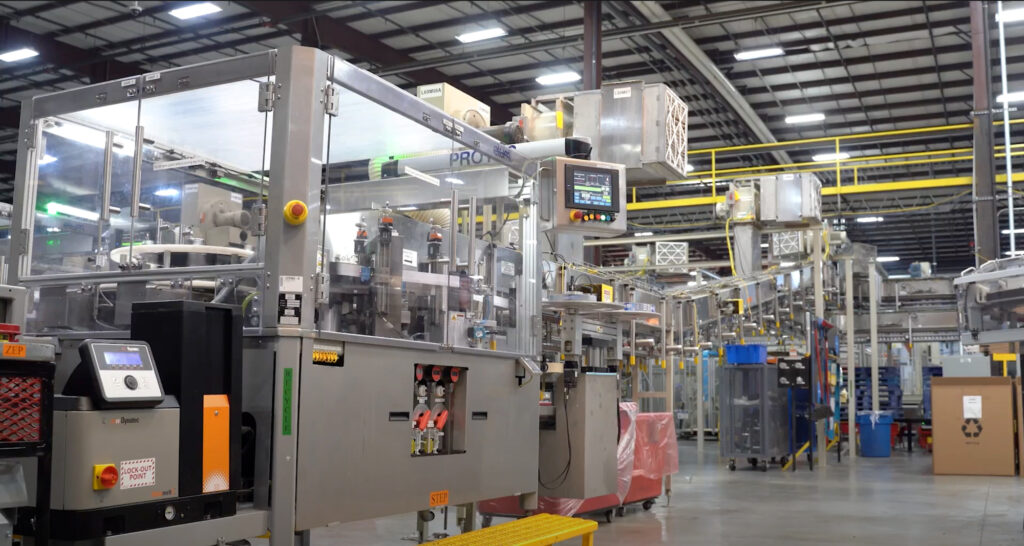
The optimal labeling solution should always be solving the critical issues, not creating them. That’s why solutions like the PROTOS from Elum matter. Built on a 100% servo architecture with independent motor control, compact footprint (50% less floor space compared to traditional rotary machines) and a specially engineered adhesive system, PROTOS delivers the performance platform that makes servo-driven labeling a real game-changer.
PROTOS also solves one of the most significant issues with standard labelers and that’s glue-slinging. Our Synapse Adhesive System completely eliminates the issues of glue-slinging and provides a precise and durable label consistently without the fear of waste.
PROTOS Brings Everything Together
For bottlers who view the labeling station not as an afterthought but as a performance driver, servo-driven technology represents a strategic leap. In high-mixed, high-volume environments, where flexibility, reliability and waste reduction dictate cost structure, making the switch to a fully servo-driven labeler is increasingly the rational choice.
While the benefits are evident, selecting the right machine still requires due diligence. A well-designed servo labeler doesn’t just perform—it integrates seamlessly, supports changeover, lowers total cost of ownership and gives the line the agility to respond to market demands. Solutions like PROTOS allow manufacturers to check all of the most important boxes.
In a world where packaging demands are evolving rapidly—and operational efficiency is under constant pressure—making the switch to a high-performance servo-driven labeling machine is less a luxury and more a necessity. Bottlers who act now position themselves not just to keep pace, but to lead.